Patient Communication Mistakes That Cost Dental Practices Revenue
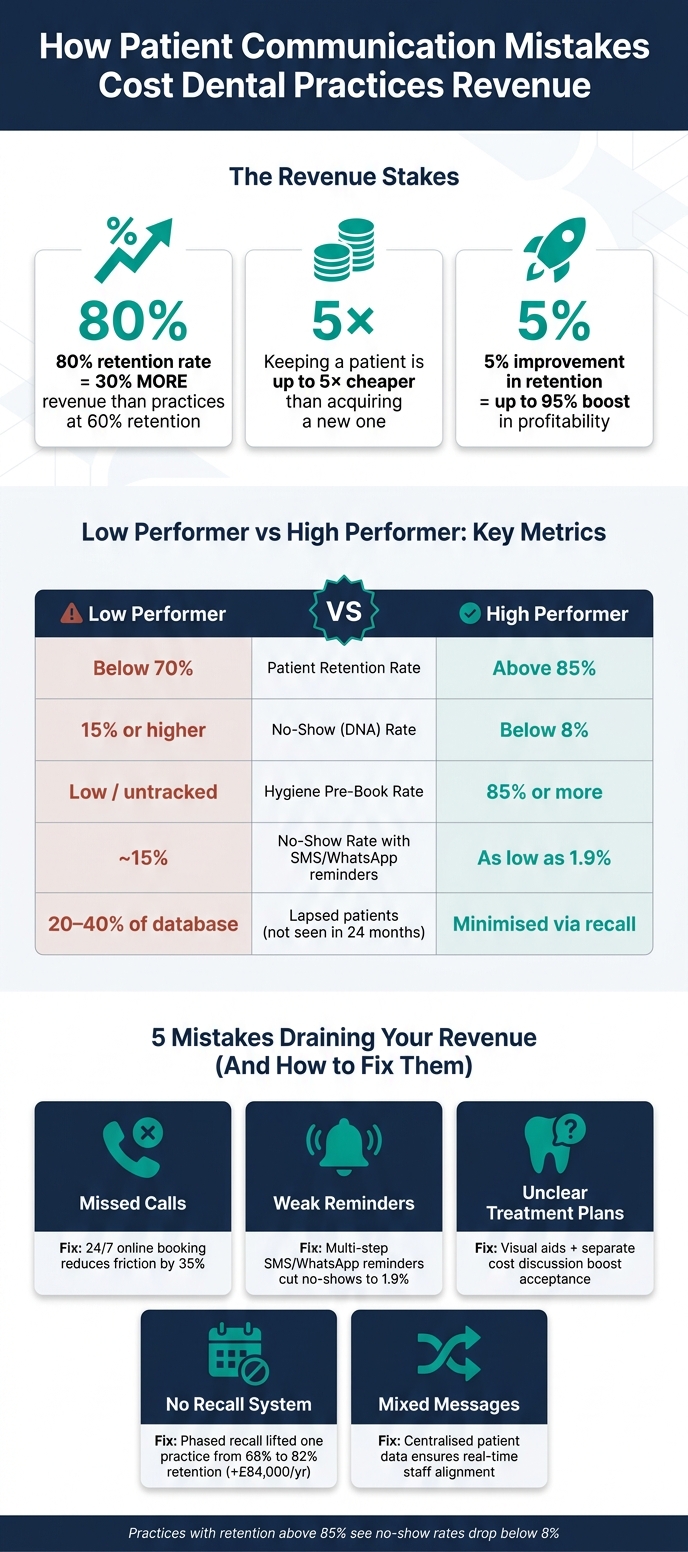
Losing patients due to poor communication can hurt your dental practice’s revenue more than you think. Here’s why: practices with an 80% retention rate make 30% more revenue than those at 60%, and keeping a patient is up to five times cheaper than acquiring a new one.
The most common mistakes include:
- Missed calls: Overloaded front desks lead to unanswered calls, costing you appointments and long-term loyalty.
- Weak reminders: Ineffective or missing reminders result in no-shows, leaving costly empty slots.
- Unclear treatment plans: Patients hesitate when explanations are vague, reducing case acceptance.
- Lack of follow-ups: No structured recall system means patients drift away, cutting into revenue.
- Mixed messages: Miscommunication between staff erodes trust and retention.
Solutions like automated recalls, 24/7 online booking, and clear treatment visuals can save time, improve patient retention, and protect your bottom line. Addressing these issues now can boost retention, reduce no-shows, and increase profitability without adding staff.
@figure {Dental Practice Communication: High vs Low Performer Benchmarks} :::
Why patient communication mistakes matter
Poor communication doesn’t just irritate patients – it hits your bottom line. Research shows that even a modest 5% improvement in patient retention can boost a practice’s profitability by as much as 95% [1]. When patients feel neglected, they often turn to practices that communicate more effectively. This can lead to real financial losses, with missed appointments and lower case acceptance rates being just the tip of the iceberg.
Empty appointment slots caused by no-shows or cancellations are tough to refill, especially without a clear follow-up system. Patients who don’t hear back may quietly switch to another practice, leaving your recall lists to grow and hygiene appointments to sit unbooked [2].
“Dental recall automation UK is not about replacing reception. It is about making sure overdue recalls, hygiene reminders, confirmations, and DNA follow‐up happen consistently, even when the front desk is busy.” - Silverstone AI Editorial Team [1][2]
This highlights how automated tools can ensure consistent communication, even during peak times when staff are stretched thin.
On top of this, trust takes a hit when patients receive generic, impersonal messages that fail to reflect their treatment history. This lack of connection can drive patients to leave negative online reviews instead of voicing their concerns directly to the practice [1][2].
There’s also a legal aspect to consider. Starting March 2026, the Competition and Markets Authority (CMA) is intensifying scrutiny of private dentistry, particularly over pricing transparency issues like “drip pricing” – where unexpected fees appear at checkout. Under the Digital Markets, Competition and Consumers Act 2024, practices could face fines as high as 10% of their global turnover [1]. Communicating costs clearly isn’t just about building trust; it’s also a safeguard against hefty regulatory penalties.
1. Missed and mishandled phone calls at the front desk
The front desk is often where potential patients slip through the cracks before they even get the chance to book an appointment. When a call goes unanswered - or is handled poorly - many patients simply move on, searching online for another option. Each missed call isn’t just a lost opportunity; it could mean losing a patient for good.
One of the main culprits? Overloaded front desk teams. Naturally, they prioritise patients standing in front of them, leaving incoming calls to ring out. This gap in operations can directly impact your revenue.
The numbers don’t lie. A single missed call can result in lost appointments, treatments, and even long-term patient loyalty. And considering that improving patient retention by just 5% can boost profitability by up to 95% [1], even a small number of missed calls each week can add up to a substantial revenue shortfall over time.
The Silverstone AI Editorial Team puts it bluntly:
“When those steps [prompts and reminders] depend on whoever happens to have a spare moment at reception, consistency usually breaks down.” [2]
The solution doesn’t necessarily lie in hiring more staff. Instead, the focus should be on reducing call volume. By offering tools like 24/7 online booking, one-click rescheduling, and pre-booking options, you can streamline operations and keep your schedule running smoothly. Research shows that online booking systems can reduce appointment-related friction by 35% [1]. Tools such as Remedico’s Smart Calendar can further ease the burden by sending automated reminders and rebooking links, allowing the front desk team to concentrate on in-clinic patients. These solutions not only simplify call management but also strengthen your approach to patient retention.
2. Weak appointment reminders and confirmation processes
Even when a patient has booked an appointment, ineffective reminder systems can lead to missed visits. Many practices rely on a single phone call the day before - or sometimes no reminder at all - leaving patients to forget, get caught up with other commitments, or fail to reschedule if something comes up. The consequence? An empty chair, while fixed expenses like rent, utilities, and staff wages remain unchanged.
Practices with no-show rates of 15% or higher often struggle with patient retention, keeping it below 70%. On the other hand, practices that maintain no-show rates under 8% tend to perform much better [1][2]. Introducing automated reminders via SMS or WhatsApp can dramatically reduce no-show rates, bringing them down to as little as 1.9% [1].
“A patient who is overdue for hygiene is not only a missed booking. They may also be drifting out of routine care, becoming less loyal to the practice, and more likely to book elsewhere.” - Silverstone AI Editorial Team [2]
Using multiple reminders rather than a single notification produces better results. For example, sending a reminder 72 hours before the appointment gives patients ample time to reschedule if needed - allowing you to fill the slot. A follow-up reminder 24 hours before the appointment, paired with a one-tap confirmation option, ensures those who missed the first message are reached [1][2]. When confirming or cancelling is as simple as tapping a button, patients are much more likely to respond, reducing the chances of a no-show. This organised system also lays the groundwork for smoother post-appointment follow-ups.
Dealing with missed appointments is just as crucial. Without an automated system to re-engage patients who fail to attend, they may drift away entirely - and could even book with a competitor before your team notices their absence [2]. Remedico’s Retention AI™ simplifies this process by automatically sending rebooking prompts after a missed appointment and delivering recall reminders at optimal intervals. This ensures your front desk only needs to step in when absolutely necessary, saving time and effort.
3. Unclear treatment explanations that reduce case acceptance
When treatment plans are vague, patients are more likely to leave without booking. If they don’t fully understand why a procedure is necessary or what the outcome will look like, they often respond with, “I’ll think about it,” and never return.
The issue often stems from information overload. When patients are presented with too many options and no clear guidance on what’s best for them, they hesitate. And that hesitation can mean losing out on high-value treatments.
Vagueness erodes trust. If patients can’t picture the results or worry the outcome won’t appear natural, they’re more likely to avoid making a decision altogether. Providing visual aids - like before-and-after photos, intraoral images, or digital scans - can make a huge difference. Tools such as Remedico’s Hyper 3D Dental Chart and Dentaverse® VR/AR platform allow patients to see a visual representation of their treatment plan, offering clarity and reassurance. This approach builds trust and helps keep the focus on the treatment itself, leaving cost discussions for a separate conversation.
Separating clinical explanations from financial discussions is another way to reduce patient hesitation. When dentists introduce treatment plans and immediately follow up with fees, patients often feel pressured or confused. Instead, having a trained treatment coordinator handle cost discussions - complete with a written fee breakdown and clear finance options - can make the process smoother. This keeps the focus on patient care during the consultation and ensures financial details are addressed in a less stressful way.
Barrier to Acceptance | What the Patient Is Thinking | How to Address It |
|---|---|---|
Unclear benefits | “I don’t understand why I need this.” | Explain the practical, aesthetic, and long-term health benefits in plain language. |
Uncertainty about results | “Will it look natural?” | Share before-and-after photos or smile simulations to set clear expectations. |
Too many options | “I’m overwhelmed by the choices.” | Use a simple comparison to highlight the best option for their needs. |
Price concern | “This feels expensive or unclear.” | Provide a detailed fee breakdown and regulated finance options. |
Fear of complications | “What if something goes wrong?” | Be upfront about risks, explain aftercare, and highlight factors that ensure success. |
Clear, straightforward communication not only builds trust but also increases case acceptance, ultimately benefiting both patients and the practice.
4. No structured recall or follow-up system
One of the most common ways practices lose patients is through a lack of consistent follow-up. If a patient leaves without scheduling their next appointment, and there’s no automated system to remind them, they often vanish from your appointment book. According to specialist consultants, 20–40% of a practice’s patient database may not have visited in the last 24 months. That’s a massive chunk of potential revenue simply left untapped.
A well-thought-out recall process isn’t just about sending reminders - it’s about recognising that keeping existing patients is far more cost-effective than constantly chasing new ones. Without such a system, lapsed patients quietly drift away, booking elsewhere or neglecting their routine care altogether.
The solution? A phased recall approach. Instead of relying on a single reminder, use a series of touchpoints to re-engage patients. For example:
- Send a text and email on the due date.
- Follow up with a phone call two weeks later.
- Add a digital reminder after one month.
- Finally, send a formal letter at the six-month mark.
This layered strategy ensures you catch patients who may have missed earlier reminders. For instance, a dental practice in Birmingham implemented automated recall texts over eight months and saw their retention rate jump from 68% to 82%. This simple change led to an additional £84,000 in annual revenue - all without spending on new patient acquisition [1].
Tools like Remedico’s Retention AI™ simplify this process by automating recall messages and follow-ups at the right intervals. It integrates seamlessly with your practice’s communication efforts, helping to recover lapsed patients and safeguard your revenue - all without piling extra work onto your front desk. Plus, under UK PECR and GDPR regulations, recall reminders tied to ongoing care are classified as service communications. This means you can send them without needing separate marketing consent, eliminating a common obstacle for practices hesitant to run recall campaigns.
5. Mixed messages from front desk and clinical staff
When a dentist explains a treatment plan to a patient, only for the receptionist to provide conflicting information at checkout, trust can erode almost instantly. This kind of miscommunication often results in fewer patients accepting treatments and a drop in overall retention - similar to the effects of other communication breakdowns.
The issue typically stems from a weak handover process. If the front desk isn’t promptly informed when a clinician updates a treatment plan, they might rely on outdated details. For instance, imagine a patient just learned they need two crowns and a hygiene appointment. If the receptionist then quotes an incorrect cost or schedules the wrong follow-up, the patient’s confidence in the practice can plummet.
This confusion directly impacts patient behaviour. Practices with retention rates above 85% usually report no-show rates below 8%. On the flip side, retention rates under 70% often correlate with no-show rates of 15% or more [1]. Mixed messages only worsen the situation - patients who feel misinformed or uncertain are far less likely to rebook. To prevent this, it’s crucial to implement a unified system that ensures all staff are working with the same updated information in real time.
The solution begins with centralising patient data. This allows both clinical and administrative teams to access up-to-date records simultaneously. Tools like Remedico’s Patient Flow™ make this possible by centralising patient information and notifying the front desk of updates as soon as clinicians make changes. For example, when a clinician adjusts a treatment plan or recall date, the front desk is alerted before the patient even leaves the chair, ensuring follow-ups and reminders align with the clinician’s recommendations.
It also helps to assign one person - whether a treatment coordinator or a dedicated front desk team member - to handle all discussions around costs and financing. This approach ensures consistent communication and simplifies decision-making for patients.
How to fix communication mistakes and protect revenue
Fixing communication issues often comes down to simple solutions. The trick is pairing clear team protocols with automation to ensure nothing slips through the cracks.
Automate repetitive tasks first. Things like appointment reminders, recall notices, and follow-ups for missed appointments don’t always need to involve a receptionist. By automating these, your front desk team can focus on patients who genuinely need one-on-one attention. As the Silverstone AI Editorial Team explains:
“Dental recall automation UK is not about replacing reception. It is about making sure overdue recalls, hygiene reminders, confirmations, and DNA follow-up happen consistently, even when the front desk is busy.” [2][1]
A phased recall sequence works well to keep things moving. For example, send a text and email with a direct booking link on the due date. If there’s no response after two weeks, a personal phone call is often more effective than another automated message. At one month overdue, follow up digitally again. After six months, send a formal letter. This structured approach avoids overwhelming your team while keeping patients engaged and ready for exception-based management in appointment confirmations.
Adopt a “manage by exception” strategy for confirmations. Automate 24-hour appointment reminders for every patient, and let your front desk step in only for unconfirmed bookings. Tools like Remedico’s Smart Calendar can flag these unconfirmed slots automatically, helping your team focus where it matters most.
For patients who leave without scheduling their next visit, automate a follow-up message with a direct booking link on the same day. Sending reminders tailored to the patient’s preferred channel - whether that’s SMS, email, or WhatsApp - can boost booking rates by up to 45% [1]. Remedico’s Retention AI™ handles this seamlessly, sending follow-ups across channels without any manual effort from your team.
To take it a step further, integrate clinical data into your scheduling process. Instead of sticking to a generic six-month timer, pull recall dates directly from clinical records. This ensures your reminders align with NICE and NHS guidelines, basing communication on each patient’s actual clinical risk rather than a one-size-fits-all schedule. Practices with retention rates above 85% often see no-show rates drop below 8% [1]. By keeping reminders consistent, ensuring clear handovers, and centralising patient data, your practice can safeguard revenue while transitioning to a more efficient communication system.
Conclusion
Every step in a patient’s journey - from the initial phone call to the follow-up after a missed appointment - holds the potential to either strengthen or weaken their connection to your practice. Missteps in communication at any stage can quietly chip away at revenue, often going unnoticed until the impact becomes undeniable.
The good news? Most of these issues can be resolved without needing to expand your team. Simple steps like automating appointment recalls, tailoring reminders based on treatment types, and offering patients straightforward ways to rebook can significantly reduce barriers and keep your calendar busy. After all, keeping existing patients is up to five times more cost-effective than bringing in new ones [1].
FAQs
Here are some common questions dental practice owners ask about improving patient communication and its effect on revenue.
How can I measure whether better patient communication is actually improving revenue?
Keep an eye on metrics like patient retention, no-show (DNA), hygiene pre-book, and chair occupancy rates. Practices with retention rates below 70% or DNA rates over 15% are losing valuable chair time and income. High-performing practices, on the other hand, tend to have retention rates above 85%, DNA rates below 8%, and hygiene pre-book rates of 85% or more. Additionally, track recall response rates across SMS, email, and phone channels to pinpoint where patients might be dropping off before they even make it to the chair.
Does Remedico help with CQC and GDPR compliance when sending patient reminders?
Yes. Remedico ensures compliance with UK PECR and GDPR rules by classifying automated recall and appointment reminders as service communications. These messages are tied to the patient’s ongoing care rather than marketing, so there’s no need for separate marketing consent [1][2]. Remedico’s Retention AI™ manages this process automatically, sparing your team from the hassle of manual consent checks while keeping everything compliant.
What’s the most practical way to train front desk staff to communicate better with patients?
Start by equipping your staff with a simple rebooking script to use immediately after a patient’s treatment. For example: “Let’s book your next visit while you’re here - I’ve got [date] at [time], does that work for you?” [1]. This small step can make a big difference, helping your hygiene pre-book rates move closer to that 85% goal. Beyond scripts, focus on training your staff to handle exceptions: let automated systems manage routine recall reminders, while your team concentrates on unconfirmed appointments or situations that require a personal touch [2].
These strategies provide actionable steps to improve patient communication, safeguarding both your revenue and compliance.